Showing posts with label Process. Show all posts

Wednesday, December 15, 2021

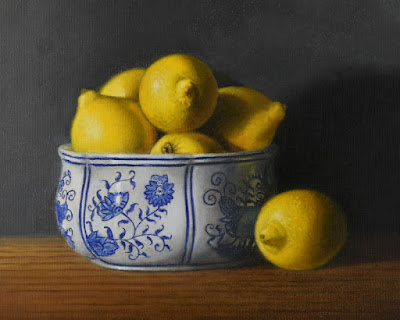
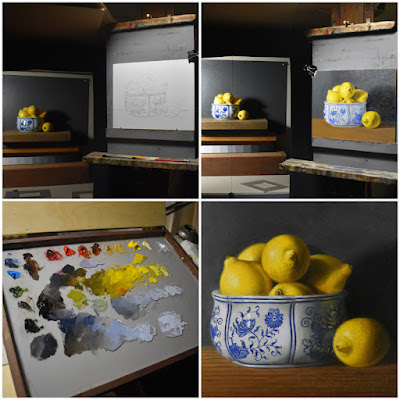
Lemons in a Bowl - WIP


Lemons in a Bowl, oil on panel, 8 x 10 inches, Jim Serrett

Finished. About time too, the lemons hung in there as long as they could. This piece took far longer to complete than expected, but you must do what is right for the picture to best communicate your intention. Art takes patience. Trusting the process helps me to be patient.


Progress shots, drawing, first pass, color mixing, final pass.


Explore - Question - Learn - Enjoy, Jim 


Wednesday, October 13, 2021

Button Jar


"Everything has beauty, but not everyone sees it." -unknown

I have wanted to paint this jar of buttons for a while now but was always afraid of how it would read to the viewer. How to visualize so much confusion in such a small space. It was more conceptual painting than the optical paint of what I see. For a realist artist this is the balancing act.

Button Jar, Oil on panel, 10 x 8 inches, Jim Serrett


Explore - Question - Learn - Enjoy, Jim 


 Website - jimserrett.com 
 Studio Blog - jimserrettstudio.com 
 Landscape Blog - Pochade Box Paintings


Friday, October 8, 2021

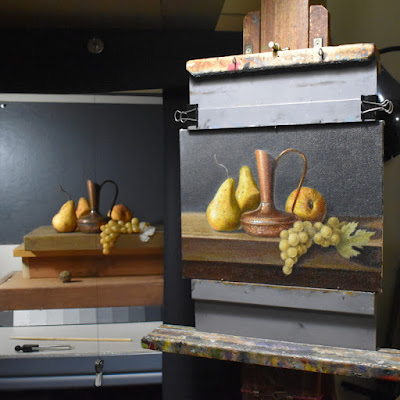
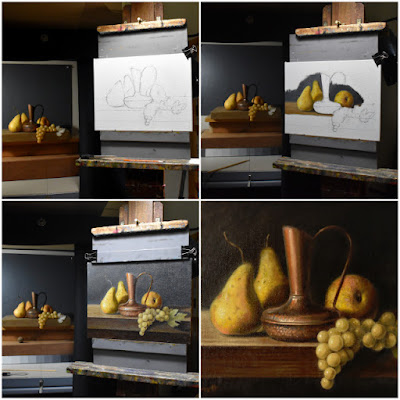
Bosc Pears with Copper Vase - WIP


Bosc Pears with Copper Vase, Oil on panel, 9 x 12 inches, Jim Serrett


 The Bosc pears barely made it to the end of this painting, the gnats in the studio were a message to finish up this piece. Pears tend to be a theme I repeat, as do many artists. Not exactly sure what attracts us to them, maybe the organic shapes and variety of colors. The little vase came from Italy.

 Progress shots, drawing, first pass, second and final glazing pass.


Explore - Question - Learn - Enjoy, Jim 


Wednesday, June 9, 2021

Silver Bowl with Apples - WIP


The cloth was an interesting subject to paint. The lace work was challenging to translate. I tried not to overstate it and compete with the apples. I kept thinking about the ying-yang of negative-positive spaces, the play of light and shadow through the open fabric and simple truths. If art is hard work, it is because you are struggling to go beyond what you know and looking for that poetry in your art.


Progress shots, drawing, first pass, color mixing, final pass.
Silver Bowl with Apples, Oil on panel, 8 x 10 inches, Jim Serrett


Explore - Question - Learn - Enjoy, Jim 


Landscape Blog - Pochade Box Paintings


Monday, January 18, 2021

Silver Bowl with Pears - WIP


The silver bowl had several value variations with subtle temperature changes. I used warm and cool color strings of grays working back and forth between the two to model the form and state the reflections. The “palette”, where little piles of colors are mixed and pushed around is mesmerizing to us paint nerds. Those little puddles are storytellers, they are a living chronicle of the painting’s creation.


Progress shots, wipe-out, first pass, color mixing, final pass. 
Silver Bowl with Pears, Oil on panel, 10 x 8 inches, Jim Serrett


Explore - Question - Learn - Enjoy, Jim 


 Website - jimserrett.com 
 Studio Blog - jimserrettstudio.com 
 Landscape Blog - Pochade Box Paintings


Wednesday, May 20, 2020

Craftsman


I had not done a full underpainting in a while; I forget how magical this process can be. Glazing color over the grisaille creates an illusion of depth that is hard to achieve in any other technique. Progress shots, drawing, umber wipe -out, grisaille, color pass.

Grisaille – (griz-eye’) fr.- grey an underpainting done entirely in monochrome shades of gray.


Craftsman, oil on linen panel, 11 x 14 in, Jim Serrett


Explore - Question - Learn - Enjoy, Jim 


 Website - jimserrett.com 
 Studio Blog - jimserrettstudio.com 
 Landscape Blog - Pochade Box Paintings


Thursday, January 23, 2020

"Is not what you look at that matters, it's what you see."


I seem to paint a lot of bottles. A friend recently asked me why? I see a still life as a visual meditation, and glass can be a mental challenge in that you must decide what is effective and what is not in explaining the image.  It is walking an edge of what is optical information (that what we see) and conceptual information (that what we know) to express form and imagery. 

The simpler explanation is that old glass bottles are cool.


Marbles with Bottles, oil on panel, 10 x 8 inches, Jim Serrett


"Is not what you look at that matters, it's what you see." -- Henry David Thoreau


Explore - Question - Learn - Enjoy, Jim 


Website - jimserrett.com 
Studio Blog - jimserrettstudio.com 
Landscape Blog - Pochade Box Paintings


Friday, January 17, 2020

Marbles with Bottles - WIP


Current work in progress. Progress shots, drawing, first pass, color mixing, final pass.


Marbles and Glass, contour drawing


First Pass.


Palette, color mixtures.

"Is not what you look at that matters, it's what you see." -- Henry David Thoreau


Final pass.


Marbles with Bottles, wip, oil on panel, 10 x 8 inches, Jim Serrett


Explore - Question - Learn - Enjoy, Jim 


Website - jimserrett.com 
Studio Blog - jimserrettstudio.com 
Landscape Blog - Pochade Box Paintings


Friday, September 13, 2019

The Plumb Line and String of Thought


I spend a great deal of time sorting objects for a still life, arranging them and looking at the set up. I will contemplate the surfaces, shapes, reflections, positive-negative spaces and assemble the composition. Then looking at the overall design and playing around with it, add and subtract things until I get something that “feels’ right. All the while looking through a view finder for a sense of how it will look to scale on canvas. I try not to rush this part of the painting process, knowing that I am going to make a commitment of time and energy. I want it be something worth the effort and not have one of those last hour, “good grief what was I thinking" moments.

Now that I have a design I like. I need to transfer the image to paper or canvas. In almost every painting or drawing setup of mine you will find a plumb line. A very simple but most useful tool for artists.

Webster’s definition of plumb line is.
1 : a line (as of cord) that has at one end a weight (such as a plumb bob) and is used especially to determine verticality   


OK, so it’s a cord or string with a weight on it. 

More important is that it is a drawing tool, a vertical line from which you can measure any point. Plotting out the dimension and placement of objects and the alignment of elements.


Plotting the drawing and blocking out.

To scale the drawing, you need a measuring device, something you can move your thumb up and down and make visual measurements from quickly, for comparison. You can use a piece of charcoal or a brush handle works. I like chop sticks as they have a uniform thickness up to the point. 

After setting up the still life and establishing a viewing point (the spot you will use to make all your observation from), establish a vertical axis through the composition. Use a plumb line or scale edge held at arm’s length. I place the subject and artwork where I can see both in one glance and flash my eyes back and forth between the two and make comparative measurements. Always using my reference of the plumb line from my vantage point.

Hang your plumb line so that it visually kisses or intersects edges. In the Moka pot I have the plumb line falling down the straight edge of the upper part of the pot. I draw that line on my paper for the first placement. Then using a pencil at arm’s length, I establish a unit of measurement. I measure widths and heights from this virtual line. How tall the pot, how wide, how far over is the garlic clove.


Once you establish the size of one part, compare it to another and build on those relationships, establishing one measurement that you compare the next measurement to and so on, growing a set of ratios. As you develop the drawing you will check your dimensions often. I like to refer to this as plotting out the drawing. Develop a set of points you can use as constant reference, after plotting all your reference points block out the basic shapes with simple straight lines. Keeping it as uncomplicated as possible, keeping the marks simple makes it easier to rearrange them until you have their placement correct.


My goal is a accurate drawing and solid foundation for my painting.

This is mainly a Comparative Measurement process based on my adapted version of the “Sight-Size Method”, there many links and articles about this topic online and a wealth of information at Darren Rousar’s website.

I absolutely recommend spending some time there.

The sight-size method is great tool for artist to understand and adapt to their process. I think sometimes it gets a bad rap because of its academic pedigree or it being too mechanical. But, every representational artist: no matter how loose they paint, plot the positioning of the elements in their picture plane with some type of mark or mass of paint. This process when applied to a direct method of painting can be very fluid and energetic.

I want approaches which allow me to understand the elements required to represent three-dimensional space in painting. Good drawing skills are the first element of that. To help achieve that goal make use of any drawing aids that will train your eyes and hand to draw proficiently. As you progress most of those tools will become second nature. I have always liked the idea that to master a skill you must own it.


String of Thought

My line of thought is to get the main idea down, blocked in or sketched out as quickly and accurately as possible. I want to see the main impression, or what is the “big” picture?

From there the general approach is to continue bearing down on the elements in the painting, making smaller adjustments, dialing in on the image I want to see. Thinking big to small, simple to complex, general to specific. Until I reach the illusion of realism I want to imply.

This can seem like a slow process to some, but when done consistently you will find it very effective and quick. But the point of the process is not speed but slowing down and engaging with the image. Painting is both time consuming and time slowing.

If you are not going to get a thrill, how can you give someone else one? 
You must feel the beauty of the thing before you start.   ---- Charles Hawthorne 

I paint what captures my eye, often those small things overlooked. The reflection in a glass, the atmosphere around an object, the ying-yang of negatives-positive spaces, the play of light and shadow. Those qualities that resonate with me in art are skill, beauty, poetic feelings and simple truths. These are the qualities that transcend mere representation and I aspire to.


I certainly enjoy the process of painting, building layers of glazes and color – modeling form. It is a very sensual medium. But it does go beyond the technical and observational skills, craftsmanship is just the conduit for authentic self-expression. If art is hard work, it’s because you’re struggling to go beyond what you know and looking for that poetry in your art.


Explore - Question - Learn - Enjoy, Jim 


Website - jimserrett.com 
Studio Blog - jimserrettstudio.com
Landscape Blog - Pochade Box Paintings


Sunday, September 30, 2018

Eat More Art


Its hard to imagine that summer is over. 
Seems like we were just getting started? 
Where did she go?

And like everybody else there is always a list of honey do’s and DIY project around the house that just don’t make the completion list. I will say it’s not from the lack of effort but more that agendas quickly change, kind of... life happens.

For this artist/painter there is always some unfinished business. Always a few unfinished canvases, neglected sketches, and unrealized ideas. However, I have come to learn this is part of the process, creating art is not a linear thing. It must remain fluid, you cannot let it become a regimented system if you do let that happen then you’re missing so many possibilities. You will never know where things may lead. There are different paths that need to be explored.


Let me be clear, I am not talking about abandoning your artistic voice or changing hats so to speak, because I really believe in the 10,000 Hour Rule Theory.  The principle holds that 10,000 hours of "deliberate practice" are needed to become world-class in any field.  You’re just not going to be a good at any one thing without practicing and focusing on it. It’s not like I am going to stop creating representational art and take up Jackson Pollack drip paintings.

But I am talking about the willingness to explore your art, make messes, create failures and play with the process to learn what you are capable of and what the medium is capable of. The only way to improve your art is to create more art. I have a saying for that, “Eat More Art”.
What does that adage mean? Eat More Art.

Simply devour more art, bring more art into your life, see more art, engage with more art. As an artist and a patron, go to art openings, museums, visit artists’ studios, support living artists. Follow your passion, be inspired. Create more art.

Never stop

Eat More Art.


Explore - Question - Learn - Enjoy, Jim 


Website - jimserrett.com 
Studio Blog - jimserrettstudio.com 
Landscape Blog - Pochade Box Paintings   


Wednesday, November 29, 2017

Paint what you see not what you think you see.


On my drawing table I have a small note, an axiom which states,
 “Paint what you see, not what you think you see.”

I'm not sure where I first heard this saying, I just know it has been in my studio for a long time, longer than I remember. I’ve found it scrawled on notes and inside sketchbooks dating all the way back to my early Art School days. It just keeps resurrecting itself.

It's one of those things that is easier said than done. Sounds very simple, until you attempt doing it.

And it is one of those sayings that is hard to explain. An important idea to understand but a concept that is almost a contradiction in terms. Which is probably why it keeps showing up in notes around my studio work space.


As representational artists/painters we are interested in depicting the world around us, however as we attempt to do that we find that paint has its limitation when compared to the real world, that we cannot paint as bright a white or as dark a black as we see them in nature. And that if you describe literally everything you see in a subject in detail verbatim, you will give yourself and the viewer a mental overload. Too much detail can kill a painting, and vise versa, being overly simplistic and too idealized the less realistic.

We are supposed to be more than visual recorders of facts, not simply replicating what you see; but artists, creating a piece of art which portrays the real world in some meaningful way that moves and touches the senses of another human being. So how do you make a realistic representational image that does that? Which is why the saying “Paint what you see, not what you think you see.” sounds like such a contradiction.


With my still-life’s I can do controlled studies like this where I can investigate the subject. The whole idea for me is to slow down and really see what it is that is front of me, to see form, color, space. Not objects, when I see or think objects, all kinds of preconceptions come up, I think the image, some idealized version of the image more than see the thing in front of me. So, I cannot let preconceived ideas get in the way. You must investigate the subject…explore it with the eye of a painter…form, color, edges, light, atmosphere, and how one relates to another. Discover relationships between those elements and look for those nuances that make it unique and interesting, it is one of the hardest things to do,  to let go of what you think you know.


But when you are attempting to paint realism, knowing how to suggest information is more important than knowing the fact. The average person's head has up to 150,000 hair follicles but I would never attempt to paint them, only imply them. A glass bottle is transparent and an apple solid, but I would not paint them the same way, but imitate the differences of their forms. Much of my time is spent figuring out how to convey the character of a thing by texture, shape, color, value, edges that makes a convincing illusion of realism.

It is about creating imagery that reads convincingly to the human eye. So, we will manipulate and alter the imagery responding to the complexity of the subject and to make aesthetic adjustments. The human eye sees the world in shape, color, forms, light, shadow and deciphers that information to represent the natural world. We paint an impression of that information and attempt to set it into a picture plane with an illusion of space and depth. With abstract brush strokes, lost and found edges, and other paint manipulation you suggest and imply “hopefully without getting too gimmicky”, an illusion of the thing in front of you. All the while keeping it simple and true to subject so that it can be considered naturalistic and real. See what I mean easier said than done.


Once you jump that mental hurtle you can really see what’s in front of you, then you can begin to play with the object and express your idea or emotion about the subject.  It becomes a new discovery. And in that discovery, you will open new eyes, those of your viewers and your own.

That sense of wonder, when you move past merely the representation of a thing and transcend it becomes the illusion of nature seen through a poetic eye. It seems that learning to see, is just as much about learning to unsee.

Which just might be another one of those axioms that is hard to explain…


Silver Cup, Egg and Bottle, oil on panel, 10 x 8 inches, 2017© Jim Serrett


Explore - Question - Learn - - Enjoy, Jim 


Website - jimserrett.com 
Studio Blog - jimserrettstudio.com 
Landscape Blog - Pochade Box Paintings


Sunday, April 30, 2017

Enjoy the Process


In this age of social media we are bombarded with imagery. It may be good to see what everyone else is doing. Follow artists whose work you admire and most want to emulate. There is value in setting the bar high, it keeps us reaching and hopefully teachable. But a constant game of comparison is not healthy, in fact it can be downright stifling to your own growth. Sometimes I think we are not even aware of it with all of the liking, hearting, thumbs up, thumps down, all the signaling of satisfaction and approval (or of rejection or failure) cannot be healthy in the long run. It is very easy to get caught up in all that social media “trophy hunting.”

The answer to combating all the digital noise for me is to simply turn to the process, the act and craft of painting.

Quiet the inner critic by focusing on what the painting experience is teaching you. Fall in love with the process; the whole creative learning process, the ideas and concepts which go into the creation of a painting. Recognize that part of the process is failure, be willing to fail and be teachable. This is where the best lessons you learn come from. “Failure is success in progress” to quote Albert Einstein.

Don’t block the process with endless comparison, you have no idea what their journey is all about. As artist we are supposed to create a personal voice within our artwork. It should be stamped with our unique DNA filtered through our experiences and knowledge of the world expressed in and through our art. Our emphasis should not be on producing a finished “work of art” but rather on the practice and development of a fundamental skill set.

To accomplish that - work at your craft daily, it is progress not perfection.

As the process is more important than the finished work.


 “Failure is success in progress” ― Albert Einstein


Explore - Question - Learn - Enjoy, Jim 


 Website - jimserrett.com 
 Studio Blog - jimserrettstudio.com 
 Landscape Blog - Pochade Box Paintings